Showing posts with label Literary Fiction. Show all posts

Thursday, February 3, 2011

Book Review: Lucia, Lucia

Title: Lucia, Lucia
Author: Adriana Trigiani
Genre: Literary Fiction
Rating: A+

140-Character Summary: In 1950's NYC a large Italian-American family grapples with what it means to support each other through all of life's ups and downs.

First 140 Characters of the Book: "From her window Kit Zanetti can see absolutely everything that happens on Commerce Street. The name doesn't really suit the street; it should..." (p. 3).

140-Character Review: Told in flashback, this tale of family and friendship rings with an authenticity and pain that will make you cry. And yearn for the 1950's.

140-Character Recommendation/Market Placement/Entry Point: Fans of "Women's Fiction," like Belong to Me and Digging to America will enjoy this (not-always-happy) tale of strong bonds.

Wednesday, December 22, 2010

Book Review: The Financial Lives of the Poets

Title: The Financial Lives of the Poets
Author: Jess Walter
Genre: Literary Fiction
Rating: A+

140-Character Summary: Middle-aged man loses his job as a journalist after an ill-fated turn as a financial advisor/poet. Tries to provide for his family with pot.

First 140-Characters of the Book: "Here they are again-the bent boys, baked / and buzzed boys, wasted, red-eyed, dry-mouth / high boys, coursing narrow bright aisles / hunting..."

140-Character Review: Humorous tale of middle-aged male ennui. Redeeming narrator caught in a tough spot with a conscience. Don't be worried, it's not all poetry.

140-Character Recommendation/Market Placement/Entry Point: Fans of Nick Hornby who have grown up and want their characters to have grown up too. Fans of Tropper who want their books sans R-rating.

Sunday, June 6, 2010

Book Review: Beginner's Greek

Title: Beginner's Greek
Author: James Collins
Genre: Literary Fiction
Rating: B-

140-Character Summary: Boy meets girl on a plane, gets her number. Boy loses number. Boy's best friend marries girl. Best friend dies... and other coupling/drama.

First 140 Characters: "When Peter Russell boarded an airplane, he always wondered whether he would sit next to a beautiful young woman during the flight, and..."

140-Character Review: This book kept me hooked (pretty much). The writing was good (pretty much). Skimmed some descriptions (of scenery), but climax/end was good.

Hogwarts Challenge Notes: Muggle Studies
This is a classic study of human nature.

Tuesday, April 6, 2010

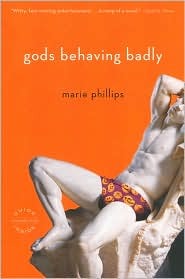
Book Review: Gods Behaving Badly

Title: Gods Behaving Badly
Author: Marie Phillips
Genre: Literary Fiction (Light)
Rating: B

140-Character Summary: Seven Greek gods living in a London flat; Apollo and Aphrodite fight; The sun goes out; A cleaning lady and boyfriend caught in the middle.

First 140 Characters: "One morning, when Artemis was out walking the dogs, she saw a tree where no tree should be. The tree was standing alone in a sheltered..."

140-Character Review: Charming love story with LOTS of lewd acts, coarse language, and irreverence toward the Greek gods. Fun characters in an interesting novel.

Hogwarts Challenge Notes:
Charms (Average People Become Heroes)

Monday, February 22, 2010

Book Review: A Reliable Wife

Title: A Reliable Wife
Author: Robert Goolrick
Genre: Literary Fiction
Category: Historical Fiction
Rating: B-

Summary: Ralph Truitt has been single for 20 years and posted an add in a Chicago paper, requesting a reliable wife. Catherine Land responded to the add saying she was a simple, honest woman. Neither were being honest.

First Line: "It was bitter cold, the air electric with all that had not happened yet."

Review: It's hard to know what type of book this is... Historical romance? Mystery? Literary narrative fiction? Long-winded gas-baggery? All of the above? Actually, it does touch on each of these at one time or another in the course of the book.

There is definite romance between Ralph and Catherine. Their pasts are bizarre (to say the least), but the connections between Ralph and Catherine (even in their bizarre present together) are a redefinition of love and marriage. They speak to the redemptive powers of love, forgiveness, honesty, and sacrifice.

There is mystery. Both Ralph and Catherine have secrets. And Goolrick writes in a way that has you wanting to unravel the secrets and see the eventual unfurling of the plots. The premise of the story is simple, but the execution is highly complex. (And the mystery supports the romance in an entirely non-cheesy way, so kudos on that.)

The writing style of Goolrick is definitely prose-tastic. He writes beautifully. He writes dense and complex introspection. However, he does get long-winded and cross over into the land of pat-myself-on-the-back-for-how-long-I've-made-this-paragraph-and/or-sentence. I skimmed a bit (more and more as I read because eventually I found that the "beautiful" prose got in the way of the book). This book definitely called for a heavier editor's hand.

The other less-than-stellar thing about this book is the characterization. I loved both Ralph and Catherine (which seems to be impossible, based on the premise of the book, but isn't once you've read the book). However, Ralph is unreal. I firmly understand that certain genres require you to suspend reality, but that's rarely the case in literary fiction. The reality suspension in this book came in the form of, "This character is too good. You will never, ever in your long-legged life meet a guy who is this forgiving. Who will say, 'Thank you for trying to kill me.'"

Other than that, it's a good book. A beautiful book. Definitely not a throw-away book. It's not for everyone, but it's a solid read.

Recommendation: Fans of other flights-of-fancy above-all-odds love stories (like Time Traveler's Wife) will appreciate this book.

Sunday, January 31, 2010

Book Review: Love and Other Natural Disasters

Title: Love and Other Natural Disasters
Author: Holly Shumas
Genre: Literary Fiction
Category: Women's Fiction
Rating: B+

Summary: Eve finds out on Thanksgiving, when she's pregnant with her second child, that her husband, Jonathan, is having an emotional affair. Are emotional affairs as bad, equivalent to, or less bad than sexual affairs? Can Eve ever trust Jonathan again? (Oh, and Eve's family and friends are worth getting to know too.)

First Line: "Some years, I gaze around the Thanksgiving table and I feel almost painfully grateful for my own bounty, for the abundance that is my life, for everything that brought me to this moment, with these people, inside this light. And some years, I just eat turkey."

Review: For reasons beyond the scope of this review, let me just say that this book made me not want to be a writer. Holly Shumas does a pretty bang-up job of writing a book with a seemingly basic hook and keeping you interested. Writing a simple book and making it good is very hard to do. She's set the bar pretty high in this regard. (Perhaps higher than I would ever be able to grasp.)

This book also made me incredibly fearful to ever get married. Shumas is a marriage therapist and I think she might have been writing from some experience. Emotional affairs are no joke. And they probably happen just as often, if not more so, than physical infidelity. The questions that the affair raises in Eve's mind are questions that I'd scarcely want to answer.

A couple of things regarding the technical expertise of this book:

1. The hook came so early in this book that I was nervous for Shumas. I wasn't sure how she was going to sustain this "forgiveness" of the emotional affair for ~300 pages, but she held her own pretty well.

2. She wasn't pitch-perfect in handling this long, drawn-out turmoil in the marriage. At a couple of points I thought, "Yep, it was bad, but you need to piss or get off the pot. Just make a decision about what you're going to do with your life."

3. The climax was kind of surprising. The climax is, not surprisingly, an emotional climax. She has set up the characters of Eve and Jonathan to fit into particular boxes, and then she kind of flips the script. She kept her hand concealed so you couldn't really see "the climax" coming, but it caught me off guard. (But that wasn't all-together bad.) (Neither was it all-together good.)

It's hard to describe the book other than to say this:
1. If you're looking for clean resolutions, don't read this book.
2. If you're looking for a "fun" read, don't read this book.
3. If you don't like to read characters who complain or are "realistic," don't read this book.

Be warned: This book is not for everyone! But, if you like reading about people who live in reality (albeit, perhaps, a reality not like your own) and can take some grief and grit in reading, than this book is totally for you.

Recommendation: People looking for a better alternative to Sue Miller (see this review) will probably enjoy this book.

Book Review: Lost in the Forest

Title: Lost in the Forest
Author: Sue Miller
Genre: Literary Fiction
Category: Women's Fiction
Rating: D-

Summary: Eva is divorced from Mark with two teenaged daughters, Emily and Daisy; she's remarried to John with a toddler, Theo. John is tragically killed and the members of the family each cope in their own way. Eva and Mark start to move back toward each other, Emily grows up, Theo fantasizes, and Daisy embarks on a path of destructive behavior.

First Line: "Emily telephoned, his older daughter, 'Can you come get us?' she said. 'It's an emergency.'"

Review: This is the second of Miller's books that I've read, and I'm finding that she has some consistent patterns. Some are good patterns, things that keep you reading; some are bad patterns, things that make you want to throw the book at the wall (or at least roll your eyes hard enough to harm your vision).

The Good Pattern: She loves the theme of messy marriages. And she's right, it's not easy. I like reading about the way she writes marriages. The way she talks about the boring aspects of being married, etc., and the way that the person you've been married to for years (or decades) can still surprise you.

The Bad Pattern: She loves the theme of sexual exploration, but she's a prude about it. For example, instead of using the word "vagina," or any of its myriad slang synonyms, she calls it "sex." Like, in this book, she talks about one character's "sex" clicking when she opens her legs. Really? You called it her "sex"? That's just stupid. I'm not opposed to the idea of using sexuality as a motif or backdrop used to tell the story of discovery, but don't be so weird about it. Her writing comes off as if she wants to talk about sex, but she's embarrased. Either do it well, or don't do it all (and I'm speaking of writing here, if you know what I mean).

I think I'm done with Sue Miller. I've got her figured out. I don't disagree that marriage is messy. I don't disagree that sexuality is a complex part of our persona. I just don't, personally, need to read her narratives of it because it can be done better.

I didn't want to finish this book. It was going nowhere fast, but she did have a good thing going in that the perspective of Daisy is told from a bit of flash-back, and you want to know how she comes out in the end. For that, she kept me reading (begrudginly). I finished, but just barely. Hence, her D- grade.

Recommendation: I recommend that you skip this book and read other books in the category of women's fiction.

Book Review: Belong to Me

Title: Belong to Me
Author: Marisa de los Santos
Genre: Literary Fiction
Category: Women's Fiction
Rating: B+

Summary: Cornelia Brown and her husband, Teo, move from NYC to suburban Philadelphia--Teo is a doctor and Cornelia is a well-educated homemaker (sans children and too much home-making inclination). Lake Tremain and her son, Dev, move from California to suburban Philadelphia--Lake is a waitress and Dev is a genius (of the 14-year-old variety). Both Cornelia and Lake's lives tangle together with the formiddable Piper Truitt (who was already living in suburban Philadelphia). The three stories seem unconnected, but they reveal (eventually) that they are very much woven together.

First Line: "My fall from suburban grace, or, more accurately, my failure to achieve the merest molehill of suburban grace from which to fall, began with a dinner party and a perfectly innocent, modestly clever, and only faintly quirky remark about Armand Assante," (Cornelia as narrator).

Summary: That first line of the book is pretty indicative of what you're going to get with reading Belong to Me. It's very literary in the way it's written (just count the number of words in that paragraph/sentence of an opening line). It's pretty clever and intriguing (I know you're wondering, "How in the world is Armand Assante going to play into this story?").

The book is, all things considered, a really solid read. Lots of complex interactions: female friends, sisters, brothers, husbands, wives, children, exes, this list could go on and on. Yet, all of these interactions are told from a very tight perspective--not a bajillion characters to keep track of. Very well drawn, if you will.

You read the book from three perspectives--Cornelia, Piper, and Dev. And, as with most really good literary works, each narrator is equally engaging. You can crawl far enough inside their persona to understand (to some degree) why they behave the way they do. There are some characters that we never get to hear from that you'd like to peek into further (Teo, Lake, Tom, Toby), but what is written is enough. Sure, you'd overindulge, if you could, but the book is definitely satisfying as is.

The primary problem with the book, in my humble opinion (and hence why it wasn't in the A range) is the pacing around the climax of the book. At the end of chapter 15, page 283, the plot "twist" is revealed. I knew what was going on. However, in a bit of literary self-congratulation, de los Santos doesn't reveal the climax to the characters until page 318, and we don't get the full impact of said climax until page 326 and following.

Now, you might be thinking, "Thirty-five pages to the 'first reveal' and another eight pages to the 'big reveal,' forty-three pages in all, isn't that long to wait." And you're right, it's not exceptionally long, but it was unnecessary. They could have easily shifted some chapters around in there and made the climax escalate at a frenzied pitch to keep you reading. But they didn't. I easily sat the book down at page 284 (as soon as I knew it wasn't going to continue with the climax, I knew I could wait to read more later). And, as I've said on this blog before, having readers be able to easily put your book down is a really bad sign. A bad sign regarding writing or (more likely in this case) editing.

And, you might be thinking, "But one editing issue gets it knocked all the way from an A to a B+? That's kind of harsh." It wasn't just once. It happened a couple of times. She [or her editor] were trying to string us along, but it didn't work. It just bogged things down.

But, to end on a happy note: because this was, by and large, a really great book, let me leave you with this snippet that tickled me (and I read it aloud to my sister because I found it to be so funny). The setting is that Dev and two friends (the female of which is a touch crazy) are in downtown Philadelphia trying to track down Dev's deadbeat dad:

"'We aren't lost,' [said Aiden]. "I just wondered if you all noticed where we are?' He pointed surreptitiously at a large, rainbow-striped flag flying from someone's balcony.

'So what?' asked Dev.

Lyssa glanced at the flag and then said, 'My mom says decorative flags are tacky.'

Aiden shook his head at this, then intoned, in a deep, radio-announcer voice, 'My friends, we are entering the heart of'--he paused dramatically--'the Gayborhood.'...

'Oh,' said Dev, quietly.

'Whoa, whoa, whoa. Hold up,' said Lyssa, turning to Dev, her pale blue eyes round as quarters, her eyelashes weedy and ink black in the noon sunlight. 'Your dad is gay?'...

'I don't know,' [said Dev].

'Oh, you'd totally know,' said Lyssa, tightening her ponytail. 'God, it would suck to have a gay dad.'

'Shut up, Lyssa,' said Aiden.

'Well,' said Lyssa, loftily, 'I'm sorry, but I just don't believe in it.'

'You don't believe in gay people,' snickered Aiden. 'Like believing in them is optional? Like gay people are the Easter bunny?'"

Recommendation: I didn't realize it before reading, but Belong to Me is actually the second book of de los Santos' with Cornelia and Clare as key characters. The first was Love Walked In; therefore, if you enjoyed this one, then you should pick that one up too. (Or vice versa.)

Monday, October 5, 2009

Book Review: How to Talk to a Widower

Title How to Talk to a Widower
Author Jonathan Tropper
Genre Literary Fiction
Category Women's Fiction
Rating A+

Summary Doug Parker is 29 and his beautiful, slightly-older 40-year-old, wife dies tragically. He spends a year in mourning (of the sleeping and drinking copiously variety) and then, after some pushing and shoving by his sister, gets back in the saddle. And did I mention that Doug is also the proud step-father to a grief-stricken 16 y.o. son Russ, who is channelling said grief into rage and marijuana?

First Line "Russ is stoned. You can see it in the whites of his eyes, which are actually more of a glazed pink under the flickering yellow porch light, in the dark discs of his dilated pupils, in the way his eyelids hang sluggishly at half-mast, and in the careless manner in which he leans nonchalantly against the pissed-off cop that is propping him up at my front door, like they're drinking buddies staggering out into the night after last call."

Review I cannot review this book. I can simply say that this book made me laugh and cry copiously. And, immediately after finishing, I wanted to start it all over again. Also, I've bought one of Tropper's other novels (just the first of many).

Read. This. Book.

Here's one of the sections that made me laugh:

[Backstory: He's waiting for a first date to return from running one of her two sons to the ER for a stomach virus and is looking for a bathroom]

"The hall bathroom is full of bath toys, and there's a strange, donut-shaped contraption on the toilet seat, ostensibly to keep the boys from falling in when they're crapping, and it doesn't look terribly sanitary so I decide to use [the date's] bathroom, which could be construed as an invasion of privacy, but I've mopped the puke off her floors and I'm baby-sitting her [other] son, so we've got to be past all of that, right? Besides, she specifically told me to make myself at home, and at home I don't crap on a plastic piss-stained hemorrhoid donut with Cookie Monster smiling creepily up at me like a puppet with a bathroom fettish," (p. 226).

Even if that didn't seem funny, Read. This. Book.

Recommendation Fans of smartly-written novels by other beautifully-sarcastic guys such as Jonathan Franzen and Joshua Ferris.

Tuesday, September 29, 2009

Book Review: The Senator's Wife

Title The Senator's Wife
Author Sue Miller
Genre Literary Fiction
Category Women's Fiction
Rating B

Summary Delia is the long-time wife of philandering (former) Senator Tom Naughton, and she gets new neighbors on the other half of their duplex. Meri's husband, Nathan, has moved them back to the east coast (from the Midwest) for a teaching job at a prestigious university. These two women, who have little in common, meet and their lives become inextricably linked--both for the good and the bad.

First Line "From her perch in the middle of the backseat, Meri surveys the two in front--her husband, Nathan, and Sheila, the real estate agent. There is something vulnerable about the back of the head and the neck, she thinks."

Review Sue Miller is at the top of her literary-fiction-version-of-chick-lit game. She's very deft at taking women's intersecting lives and dissecting the thoughts and external forces that influence and shape them. She's relatively free of judgement, all around, as she puts both a 70-something stay-at-home wife and mother alongside a 30-something working wife and mother. Neither is seen as perfect, nor is either seen as not being in control of her station in life.

In addition to crafting the inner lives of her characters well, Miller is good at creating supporting characters and setting. Houses and towns, streets and parties are well populated and easy to imagine.

I think, if possible, the only thing I'd like to see Miller do is get us more into the minds of the male characters in the book, perhaps through dialogue. Both of the husbands remain enigmatic throughout the book--you know that they love their wives, each in their own way, but you also know they're both complicit in some of the problems that occur during the book. And, as much as you get a peek inside of Delia and Meri's thoughts, you're always left guessing about what the guys are thinking. The women become self-contained bubbles, often speculating on what others think, but rarely taking the steps necessary to either confirm or deny their suspicions.

Of note: I did count her down because Miller did a very weird thing where, instead of referring to the vagina technically or with a relatively-contemporary pop culture slang, she called it "sex"; i.e., "my sex was swollen." What the what?

But, while we're on the subject of "sex," Miller is pretty impressive in her ability to make sex within marriage seem really hot. Kudos to her.

Recommendation Fans of other chick-lit-disguised-as-literary-fiction titles, such as The Time Traveller's Wife, will probably like this book.

Wednesday, September 23, 2009

Book Review: The Thirteenth Tale

Title The Thirteenth Tale
Author Diane Setterfield
Genre Literary Fiction
Rating C+

Summary Margaret Lea is a quiet, bookish young lady who helps her dad run a seemingly inauspicious rare books shop in England, and she does a little biography-ing as a vanity project on the side. But suddenly she is right in the middle of many people's fantasies when the renowned author Vida Winter solicits her solitary assistance in writing her biography. Vida is a noted recluse, and Margaret would be crazy to pass up this opportunity, but she worries that finding out Vida's beginnings will make her have to come to face her own.

First Line "All children mythologize their birth. It is a universal trait. You want to know someone? Heart, mind and soul? Ask him to tell you about when he was born. What you get won't be the truth; it will be a story. And nothing is more telling than a story," (Front Matter).

Review This book was very meta for book lovers. The passages about the power of stories, the writing process, and reading to the point where you lose yourself in a book were charming to read. However, I know there are a fair number of people who don't like to read fiction books about books. (That's definitely not me.) But if that's you, then I say: This book isn't about books, it's about personal stories, intrigue, mystery, family, and so much more.

This book is written (largely) as Vida Winter telling Margaret Lea a bunch of stories, and you're learning them right along with Margaret. I found myself engrossed in the storytelling. The stories were far from happy or bright (much of this book takes the form of a modern re-interpretation of Jane Eyre with its gothic themes and motifs), but it was definitely rich. The settings were robust (you saw them with your own inner eye), the feelings were deep and often painful, and the characters were so conflicted and confusing that you were bound to them.

But by way of justifying my "C+" rating, let me just say that this book wasn't absolutely perfect. One thing I struggled with was that I couldn't get a firm grip on a timeline or people's ages. I didn't know when the current story was happening in time. Was it 2006 and the narrator is just a little bit of a lover of old-fashioned things? This is plausible, but equally plausible is that Vida was telling her story to Margaret in the 70's or 80's. Twenty to thirty years makes a good bit of difference. I assume it's older because Vida references a time when a governess comes and looks after the teenage girls, and some anachronistic goings-on in the old time village, but it's never clear. I found that to be difficult in so much that the ending didn't fully resolve because I was unsure as to how the final characters would live (simply because I had no idea how much longer they would be living).

Another thing that bothered me is that the "original" theme of this book (apart from themes borrowed from Jane Eyre) was the profound power of being a twin. The idea that when your twin is taken from you (through death or the meddling of a governess and/or town doctor), you lose half of your own soul. The imagery that Setterfield used to create this idea, and her repetition of this situation, got to be irritating. It did not speak to me (perhaps because I'm not a twin, nor have I ever known twins to speak in this manner) and distracted from the major moving of the book. Other characters in the book (namely the titular mother and uncle) were not twins, but were still able to experience a profound (and perhaps disturbing) bond. The element of being a twin was, in my opinion, not necessary to the success of this book, but was focused on so extensively that it detracted from the otherwise redeeming qualities.

However, that aside, this book of a story within a story (and a little mystery that you can try to figure out along the way) was positively charming, was written with rich language, and well worth the read.

Recommendation Fans of books with intrigue, romance, family dramas (and writing) as themes, such as Atonement, are likely to enjoy this book.

Thursday, September 17, 2009

Book Review: Beowulf on the Beach (with Middlemarch)

Title: Beowulf on the Beach: What to Love and What to Skip in Literature's 50 Greatest Greatest Hits
Author: Jack Murnighan
Genre: Non-fiction (Literary Criticism and/or Review)
Rating: A-

Summary: Dr. Smarty Pants (aka, the down-to-earth Jack Murnighan) gives you a low-down on 50 of the world's greatest books. He tells you what's sexy, what's skip-able, and why this book will rock your world if you'll just give it a chance. He aims to bring the lofty and esoteric of literature down to the huddled masses of the world so we can enjoy it too.

First Line: "What, you weren't planning on packing Beowulf with your flip-flops and sunscreen? How about Ulysses, Don Quixote, or The Illiad? But you still feel bad about not reading them, right?" (p. 1, Intro).

Review: I do admit that I have a fondness (and maybe a little bit of a crush) on this author. I mean it, let's get real, what guy was born a Hoosier, has a PhD in Medieval Literature from Duke, has read the Bible of his own free will (more than once), and writes insanely interesting and sexy articles for Nerve.com? I'm pretty sure you can't find that combination anywhere else on that planet. (Plus, the guy's an involved donor-dad and not bad looking to boot. Too much.)

But lest you think I gave this guy an above-average grade just because I've got the hots for him, let me clarify: this book is really, really good. (I'm a genius, right?)

Here's why this book is good: it does what it's supposed to do. Accomplishing your objectives goes pretty far in my opinion. Did I agree with everything he said? No way. Do I think at times his irreverence can go a bit far? Sure. Does that make this a bad book? Not too much.

Here's how I approached this book (which I don't think should be read as a cover-to-cover read... let it be your guide):
1. I started out by reading the intro (which is generally a good place to start); this let me get a feel for his style, his writing, and his take on literary things in general. Up to this point, I was with him.
2. Next, I checked out a couple of chapters on books I'd previously read (including, but not limited to, Pride and Prejudice, Beloved, and The Bible--Old and New Testaments--all of which are books that I have loved reading at one time or another); this gave me a frame of reference for his views on literature a little more specifically as I compared and contrasted with my perspective on things.
3. Finally, I read a couple of chapters on books I had wanted (but been reticent) to read (Don Quixote, Wuthering Heights, Paradise Lost, and Middlemarch) and decided to test his opinions in real time.

I picked up a mega-used copy of Middlemarch at my local 1/2-Price Books retailer and set about to read it in a matter of months over the summer. I was persuaded to participate in this little experiment because of the associated B on the B Summer Reading Challenge hosted at Books on the Nightstand (because the idea of challenges with no rewards gets me excited).

Let me say this: I believe with fervent conviction that, had I not read the Middlemarch primer in Beowulf on the Beach, I would have had a ridiculously hard time enjoying this book. But, since I did pre-read the B on the B cheat sheet, I loved (loved, loved, loved) this book. This is earning a spot on my all-time-faves list. Beyond my heart-felt adoration of Ms. George Eliot (for publishing a "woman's book" in a man's world), this book knocked my socks (and shoes) off. I didn't start out loving Dorthea (and the idea that she was going to be a primary protagonist made me put the book down for about a month), but by the end she was gorgeous. She didn't change significantly; rather, the situation around her became more accomodating to her personality and I began to see that her beauty was really beauty and not posturing.

And speaking of personalities, there was plenty to go around. I did put this book down for a month, but when I came back (because the lure of no reward at the end of the challenge pushed me to do it), I picked right back up and the characters were all still vivid. The way that Eliot populated an entire city, letting you peek at the high and the low, was phenomenal. I think that my favorite character was probably Farebrother--his sacrifice for the youthful (and enduring) love of Fred Vincy and Mary Garth actually brought a tear to my eye and a lump to my throat.

But getting back to Murnighan and B on the B, I didn't give my current-author-crush a perfect grade because I didn't think he was perfect. In the example of Middlemarch, I think his assessment of Mr. Casaubon was off (he was being a little too 21st-Century American in his critique, I think). In the example of The Bible, I think his assessment of the book (in general) was off. Sure, The Bible is a piece of literature, but it's also a sacred text, and he didn't treat it as such (the snark got to be a bit much and dumbed down the actual review of the texts, in my opinion).

Now, I'm not so naive as to assume that everyone who comes from Indiana is a Christian of some stripe, but to be more balanced, I'd like to have seen him review texts from other faiths, just to see if his cynacism is directed specifically at Judaisim and Christianity, or if it's more generally applied to all religions. I'm sure that neither The Book of Mormon nor The Qur'an has risen to the level of The Bible (in terms of generally-accepted literary opinion and/or general readership), but his slights of The Bible were something that made me wonder (and put a grain of salt in how blindly I accepted his opinions on other books). And lest you think I'm just a religious nut, check out this quote as evidence that I'm not alone in this opinion.
"Many of Murnighan’s conclusions are off-base (see, for instance, his chapter on Balzac’s Père Goriot). But as with the collected writings of Pauline Kael, disagreeing with the critic can be more fun than turning to the work itself."
--Very Short List (June 1, 2009)
Recommendations: If B on the B seems like something you'd like, check out other great books that help reading the classics become more fun, such as How to Read Literature Like a Professor and 13 Ways of Looking at the Novel.

Tuesday, August 25, 2009

Book Review: The Sign for Drowning

Title The Sign for Drowning
Author Rachel Stolzman
Genre Literary Fiction
Category Women's Fiction
Rating B+

Summary Anna's life appears to be dominated by two main events: the drowning of her five-year-old sister (when Anna was eight); and the adoption of Adrea, a five-year-old deaf girl in the foster care system, whom she met as part of her work as an ASL teacher at a Deaf & Hearing Center in New York City. How these two events twine together to bring wholeness to Anna is the story told in The Sign for Drowning.

First Line "My father and Carla towed the yellow inflatable boat carrying the girls into the water," (Prologue, Page 1).

Review I read this book with a smile on my face and a lump in my throat nearly the entire way through. Then, when I was done, I returned to the front of the book and immediately re-read some of my favorite passages. My favorite parts centered around the character of Adrea and how she touched those around her. The stories of when Adrea's adoption certificate comes, Adrea finding the African violet plants at the market, Adrea getting dressed up for the poetry reading, and Adrea making her first cow-related sounds in France were charming and moving to read.

Further solidifying this short novel as a sheer pleasure to read was Stolzman's prose. Her background as a poet came through in her wonderful turns of phrases. From the beginning scenes that gripped you, as Anna watched her family frantically realize that her sister was drowning, the language of this book worms its way into your heart and mind.

But lest I give you the impression that this book was perfect, let me justify my rating of a B+.

First, as I read this book of a child adopted out of foster care, my mind immediately went to the young people I work with each summer who are part of the foster care system (check out Royal Family Kids Camp for details on this organization), and I was surprised by the language development of Adrea. Most of our children are delayed in their speech and reading skills because they haven't been in a supportive, nurturing environment that will develop those skills, but Adrea actually had exceptional communication skills. Her understanding of abstract concepts exceeded what I have learned in my educational theory classes is standard for a five-year-old. I ran this discontinuity past my stepmother, who is an ASL interpreter, and she was surprised at the idea of a deaf child being in a foster home that wasn't with deaf foster parents from the age of 15 months to 5 years (as is the case with Adrea in this story). She said that in most major cities, it holds true for Indianapolis and she imagined it would be the same in NYC, that the deaf community takes great pains to work with the CPS system to make sure that all deaf children are placed into deaf foster homes. Maybe it's not that way in NYC, but it was just a little detail that seemed out of place--in all actuality, a big detail, but nonetheless. On a side note, when Adrea is going to be left in her Parisian class by herself for the first time (page 108) and she regresses to gripping her hands--that detail was heart-breaking and beautifully written (inconsistencies about language development aside).

Another detail that I discussed with my step mom: On page 58 the narrator says, "There isn't a sign for 'drowning,'" which I asked about and my step mom said, "Sure there is," and she performed a sign that clearly looked to me like somebody drowning. She then did point out her typical ASL-related caveat--sometimes signs are regional and just because in the Midwest there is a commonly-accepted sign for a word, doesn't mean that's true in the East. I'll say this: ASL has to be a very difficult language to learn. I'll also say this: My step mom concurred that there is not a word for "suicide," as the narrator points out on page 160, you tell how the person killed themselves (shot themselves, took pills, etc.), so that detail was consistent. All that to say that sign language is a complex and variegated language that probably shouldn't be overly-scrutinized (I didn't really lower the literary rating for this book because of these language-related questions).

I did lower the grade because of the ending. Now, I'll be honest, I try to review books critically, not personally, so even if an ending isn't what I wanted or expected, it can still be good. And this ending was good, but it definitely could have been better. The first reason I think it could have been better was from an editing standpoint: On page 191 the author writes a beautiful line, "For this moment all things were well placed," and then she continues on for another seven paragraphs. The actual ending line of the book is, "I would clap [my hands] together so fast that they sang, and that they made a new shape, that they threw sparks." The last line, as the way it's written, doesn't have the finality of the "... well placed," line. I felt the book should have ended with the realization of the placement of things--not with the swimming and on and on. All this would have required is moving the paragraph with the "... well placed" line to the end of the book. This would have made a monumental difference.

But here is what, in my opinion, would have moved the ending to the category of phenomenal: All throughout the book we've been looking at how the two events--the childhood death and the adoption--were correlated and I think this should have been shown in the ending. I think that the ending should have been some kind of epilogue or post script about Anna coming home, with everything "well placed" to manifest that in her external relationships. In her relationship with Adrea at least (but there's also a dad and a boyfriend and friends where this could have been shown). One additional scene of closure for the other half of the book--the entire storyline of mother/daughter bonding--would have moved this book into realm of awesomeness. It might have made my top ten of books with that additional piece.

Don't get me wrong, it's still good, probably top 50 books. But just a little lacking in the very final scene, in the place where I got my last taste.

Recommendation Lovers of literary fiction (think Jane Smiley and Anne Tyler) will love this in-depth look at family dynamics.

Friday, June 5, 2009

Book Review: Hannah's Dream

Title Hannah's Dream
Author Diane Hammond
Genre Literary Fiction
Rating A+

Summary Hannah is a 40-some-odd-year-old elephant living in less than stellar conditions at the Maxine (Max) L. Biedelman Zoo in Washington. But Hannah's got something good going for her--her keeper, Samson (Sam) Brown, has been with her as long as she's been at Max's and he loves her like the baby girl that his wife lost in childbirth almost 40 years ago. Sam is surrounded by a colorful cast of characters that work against tough odds to make Hannah's dream come true.

First Line "Samson Brown loved exactly two things in this world: his wife and his elephant."

Review Most people wouldn't necessarily flip their lid over this book. It's one of those stereotypical literary fiction books where "nothing happens," but I fell in love with it... eventually.

The beginning was moderately slow-going for me (up to about the first 20 pages, which was for me the first two days of reading). Usually I'm a fast reader, but this was a book club selection and I try to pace myself so that the book's still fresh in my mind at the discussion meeting, so I try to take the whole month reading the book (which was ~10 pages per day on Hannah's Dream). So there I am, at the end of two days, thinking, "This is going to be one long month of reading."

And then day three...

And there was no day four because I couldn't stop. The book picked up as soon as the merry band of mis-matched characters came onto the scene. The zoo is inhabited with an eccentric mix of characters that enchanted me and are likely to stay with me for a long time. The characters who were supposed to be "bad," were flawed, for sure, but Hammond gives you their back story and they're not simply bad, they're broken down by their hard lives of struggle. I cried at times reading this book because it was heart-breaking; especially as I saw interplay between Hannah's poor living conditions and the poor conditions that many humans have to live through, and it brought up some interesting questions for me. For example: how much does prior history direct present actions and how do my judgements of others account for the other person's perspective?

The other fantastic thing about the characters is that none of them run together. There are eight characters who have regular interplay with Hannah, but they all stick out in my mind--none were "throw away" characters. Hammond was superb in giving them idiosyncrasies, not simply to be zany, but to individualize them and to enhance the story. Even one character's ex-wife who's never even really "in" the story was a richly-drawn character. Well done on that.

The other thing that I appreciated is that Hammond didn't get too preachy on animal rights. The well-educated animal trainer says at one point that she believes in what many zoos do in regards to education and research, and she doesn't personify animals, but can still recognize that they're senescent beings. That was a good balance, in my opinion, because I'd been concerned that this was going to be some zealot's cry against animal captivity or something.

I'd recommend this book to people who love character-rich novels, can handle a little bit of slow pacing, and can appreciate a good cry. (Because you will cry at the end.)

Wednesday, May 27, 2009

Book Review: Ordinary Love & Good Will

Title Ordinary Love & Good Will: Two Novellas
Author Jane Smiley
Genre Literary Fiction
Rating A-

Summaries In Ordinary Love, Smiley tells the story of a family who's matriarch was unfaithful and probes around at the long-lasting effects of that family break-up on the mother and her children. In Good Will, Smiley weaves a tale of a family that lives an unconventional "counter-culture" lifestyle and attempts to look at the effect of that choice on the elementary-aged son.

First Lines (Ordinary Love) "I don't want Joe to find me on my knees, buffing the kitchen floor with an old cotton turtleneck, but he does, and he says, 'Mom! What are you doing? Relax!'"
(Good Will) "During the first part of the interview, when we are sitting on the porch looking down the valley, I try for exactitude more than anything--$343.67."

Reviews Neither of those first lines are particularly illustrative--Smiley never tries to start with a big bang, she's very much a "slow wind-up" kind of writer, but she wrote both of these novellas with her trademarks. Let's dig in, shall we?

Characters: In Ordinary Love, Smiley got a little child-happy (five children) and I had a hard time sorting them out and keeping them straight in my head--two are never even in the story, they're merely referenced by other family members. I say, since this is a short story/novella and you won't have time to fully flesh out five children, their parents, a step mother, grand children, and two other men in the mom's life, cut out all unnecessary characters and make the others more rich. She could have easily lost two of the kids and tightened up the story in my mind. In Good Will, she was sparse and beautiful with the characters. Even with using only one narrator, I understood everybody's motivations in the story. Beautifully done.

Plot: Both novellas had literary-heavy plots (i.e., not a lot of "action"), as is Smiley's style, but they did what they were supposed to do. Both got you thinking about how the decisions of the parents affect the children. Which leads us to...

Themes: I've reviewed one other book by Smiley, the Pulitzer-winning Thousand Acres, which I loved because I am a hard-core sucker for literary fiction about family dynamics and these are two more works in Smiley's cannon that tackle that subject matter quite beautifully. The only problem I have with Smiley, and it seems to be common across all of her writing (including the nonfiction that I read) is that she doesn't know when to stop a good thing. The themes of both these stories were great, but she gets heavy-handed with the exposition at the end and tells you what the protagonist is thinking (i.e., what you should be thinking), and nearly always, it's not what I was thinking and kind of ruins it for me. I like it when a book creates a situation, brings up a theme for me to think about, and then lets me do the thinking. Please, dear authors, do not do all of the thinking for me; don't preach at me--that's what I go to church for. If Smiley had trimmed her exposition down a shade (most definitely in Good Will), this could have been an A+ book.

Finally, Setting: I don't usually go too much into the settings of books, unless it's a big draw-back, but I need to touch on it. Smiley uses the midwest a lot in her books (she's Iowa through and through) and she continues as such in these stories. It wasn't as big of a deal in Ordinary Love--travel is a theme, but not too over-the-top for it to be in your face all the time--but it was critical in Good Will. The Pennsylvania family-run, self-sustaining farm in Good Will was essential, as was it's juxtaposition with the city they lived near, and it was beautiful. She's descriptive and evocative, the farm nearly takes on a life of its own, and she seriously had me considering moving to the country (even though my heart truly yearns for the big city). She did that one very well. Kudos on using setting to enhance the story.

All in all, the over-characterization in the first story and the over-exposition in the second story brought this one down a touch for me, but it won't stop me from reading the four other Smiley novels I have sitting on my TBR book shelf.

Book Review: Digging to America

Title Digging to America
Author Anne Tyler
Genre Literary Fiction
Rating B-

Summary Two families, one American and one Iranian, adopt daughters from Korea and the girls arrive on the same day, forever intertwining the two families' lives (thanks in part to the party-throwing matriarch of the American family). Two of the grandparents who are widowed dance around a "coupling," further twining together the families.

First Line "At eight o'clock in the evening, the Baltimore airport was nearly deserted."

Review The primary emphasis of this book was intended to be addressing questions of what makes an American. Were Maryam, the paternal grandmother, who moved to the United States 35 years before the story starts; her son, Sami, who was born and raised in the United States (and spoke English with no trace of an Iranian accent, and never spoke Farsi); or her daughter-in-law, Ziba, who moved to the United States with her family when she was a teenager American? Are the adopted daughters, two Korean and one Chinese (adopted by the "American" couple), American? I don't know... nor does Tyler.

I don't mean to throw stones, but the only part of this book that bothered me was that the theoretical point of the story, to delve into what makes an "American" isn't really ever handled all that well and/or definitively addressed. This is likely because defining an American is nearly impossible. Also, I'm sure Tyler did a fair amount of research on immigration, but I find it hard to believe that this could be something that she has too much personal knowledge of--maybe I'm wrong, but her bio doesn't seem to hint at that.

That's why I had to mark the book down so much--because Tyler failed to accomplish what she said she was trying to accomplish with this book. If Tyler had said this was simply a book about the dynamics of extended and/or blended families, she would have been phenomenal, perfect, an A+. But she didn't.

Moving beyond plot and themes, let's review the characters. Tyler did her stereotypical multiple narrator delivery--Maryam, Sami, Ziba, Bitsy (the American hostess with the most-est), and Frank (the maternal grandfather of the American family who "couples" with Maryam) all get a chance to sit in the narrator's seat. Maryam gets the most attention, as she's the primary protagonist of this story, but I have to admit that my favorite narrators were Frank (he had a wry wit and pragmatic view of the world) and Jin-Ho (the Korean daughter of the American family has such a funny and unexpected view of her family and the other adopted daughter that her one chapter as narrator was a nice twist).

The short story of this review is that I'd recommend this book to people who like to read stories about family dynamics. It's not a definitive guide to international adoption and/or international affairs, but brings up some interesting questions that beg for further reading.

Book Review: The Time Traveler's Wife

Title The Time Traveler's Wife
Author Audrey Niffenegger
Genre Literary Fiction
Author A-

Summary Henry, a "Chronologically-Displaced Person" (aka, Time Traveler), meets his wife, Clare, when she's six (and he's not six) and then he continues to travel around in his time and her time, living life.

First Line "Clare: It's hard being left behind. I wait for Henry, not knowing where he is, wondering if he's okay. It's hard to be the one who stays."

Review I really liked this over-wrought love story (and if anybody tries to tell you it's not just a romance story dressed up as something else, tell them they're a liar). Even though there isn't much more going on than the romance story, it's still interesting because the time travelling aspect is kind of interesting. Niffenegger tries to do more than just write a 518-page opus to her dream guy, she asks some questions about fate and free will (and doesn't necessarily answer them).

My biggest problem with this story came during the climax when there were some inconsistencies in the story and how the crucial "event" in Henry's life occurred. Something occurs during "The Episode of the Monroe Street Parking Garage" that permanently alters Henry, but a climactic moment had already been seen (via time travel) some 370 pages earlier (22 years earlier in Clare's life) differently than when it occurred in real time. Sure, the chronology of this book is, understandably, convoluted, but I think something that was so critical to the climax of the book, an essential detail about how the male protagonist "functions" in that scene, is pretty important.

That, a fact/continuity issue, was the only thing I could come up with. Other than that I was thoroughly pleased with the book. I looked around at GoodReads.com to see what problems other people had, and found that only 8% (of 88,500 readers) rated the book as 1 or 2 stars. The bulk of their complaints was that the book was "boring" and didn't live up to the hype. The author can't necessarily be blamed for the hype--that wasn't her doing--and part of the "boringness" of the book is related to the afore-mentioned hype. As I said in the opening paragraph of this review, if you go in knowing that this is merely a love story/opus to Niffenegger's dream guy (who is surprisingly close to my dream guy), then you're unlikely to be disappointed. [Note: Dream guy is a slim-built, book-loving, poetry-spouting, multilingual librarian with a love of old-school punk.]

Also, her grade took another hit because in Niffenegger's quest to prove how awesome her dream guy is, she gets wordy with descriptions (and you know how I hate that). The laundry lists of groceries, bands, and locations in Chicago (in addition to her long-winded descriptions of the paper-making process--her first true love) get a little grating.

So, all that being said, I recommend this book to anybody who likes a "high brow" love story with a metaphysical twist, bearing in mind that they need to be able to overlook a major plot inconsistency that doesn't necessarily affect the plot, but shows sloppiness none the less.

Friday, May 22, 2009

Book Review: The Mysteries of Pittsburg

Title The Mysteries of Pittsburgh
Author Michael Chabon
Genre Literary Fiction
Rating A+

Summary The ultimate coming-of-age novel: Art Bechstein spends one relatively wild and crazy summer in Pittsburgh learning that he has no idea who he is.

First Line "At the beginning of the summer I had lunch with my father, the gangster, who was in town for the weekend to transact some of his vague business."

Review I read The Mysteries of Pittsburgh way too fast--not in that I can't remember it, but that I wish I was still reading it because it was so fantastic. Let's break down its fantastic qualities, shall we?

One: the writing. I really shouldn't have to expound on that because it's Michael Chabon, it's a given, but knowing that this was a reworked masters' thesis is evidence of his genius. What young guy is writing about other young guys with this much self-awareness? Or maybe it's not self-awareness, maybe its just his willingness to admit that people are confused and not at all self-aware and that's what made this book so great. But, just because I love him so much, let me give you an example of some of his lyrical prose:
"[My father] asked me what my plans were for the summer, and in the flush of some strong emotion or other I said, more or less: It's the beginning of the summer and I'm standing in the lobby of a thousand-story grand hotel, where a bank of elevators a mile long and an endless row of red monkey attendants in gold braid wait to carry me up, up, up through the suites of moguls, of spies, and of starlets, to rush me straight to the zepplin mooring at the art deco summit, where they keep the huge dirigible of August tied up and bobbing in the high winds. On the way to the shining needle at the top I will wear a lot of neckties, I will buy five or six works of genius on 45 rpm, and perhaps too many times I will find myself looking at the snapped spine of a lemon wedge at the bottom of a drink. I said, 'I anticipate a coming season of dilated time and of women all in disarray,'" (pp 9-10).
Don't you love that? Don't you love that yin/yang of what a 22-year-old hirsute young man thinks in his head and then how he expresses it verbally? Comic and so beautiful.

Two: the characters. I'm going to admit something to you all: I've never struggled with bisexual urges. Never. Not once. But somehow, and God bless him for it, Michael Chabon drew Art Bechstein so beautifully that I didn't know how he'd pick between Phlox and Arthur. How could you? They were beautiful too and filled in Art's gaps so perfectly. The other accessory characters (Jane, Cleveland, Art's dad, sundry gangsters, even Jane's parents and the [perhaps] retarded neighbor) were all so colorful and "round" that they made the story sufficiently complex and beautiful. There were no throw-aways.

Three: the ending. The ending is not what I wanted. It wasn't what I expected. Would I change it? Not for a million dollars. (Okay, maybe for a million, but not a penny less.) I've actually hearkened back to the ending on several occasions since reading it, revisiting what happened and what I thought of it, and (although it saddens me) I love the book because Chabon was unconventional. The pieces aren't all neatly tied off at the end, and that's gorgeous because life rarely has neatly tied-off ends. If you're looking for a "happy ending," then you'll need to go find a Stephenie Meyer book to read because Michael Chabon is never going to be your guy.

Four: the descriptions of plot and setting. I'm not a huge fan of overly-descriptive settings (I find that many books in the literary fiction category go overboard with sights, sounds, smells, textures, to the point where you're overloaded), but Chabon strikes a perfect balance. I saw the cloud factory, heard the click of heels on the library floor, rode with Art on the back of Cleveland's bike, but never once thought Chabon was being too wordy. He also does a fantastic job in describing sensual scenes as such--sensual, not overly smutty (although there is a heck of a lot of sex of all shapes and sizes going on in this book)--and the confusion, exploration, embarrassment, release, etc., of those scenes comes through swimmingly.

I'll be working on getting Wonder Boys, The Final Solution, Yiddish Policeman's Union, Gentlemen of the Road, and his short story and essay collections read in the not too distant future. He's also got a YA/middle grade book, Adventureland, that I should probably read too. Chabon's cannon is one that everyone should consume. Also (even though I've neglected to do so), I'd advise to read his work chronologically and watch his evolution and his fusion of literary fiction with genre fiction.

Thursday, May 14, 2009

Book Review: American Wife

Title American Wife
Author Curtis Sittenfeld
Genre Literary Fiction
Rating B

Summary Read about nearly the entire life of "fictitious" First Lady, Alice Blackwell (nee Lindgren) and see how all of that life (with special emphasis on one particularly critical event) has been one large cosmic build-up to a key day in the Presidency of her husband, Charlie Blackwell (who bears nearly no resemblence to former President George Bush).

First Line "Have I made terrible mistakes?"

Review I picked up this book at the airport when I finished my other book that I'd brought on the trip and needed to have something to get me back home. I am quick to admit that I have a big-time author crush on Curtis Sittenfeld, but I'd put off reading American Wife because I didn't want to read some liberal rip-off/snark of the Bushes (and I don't even particularly like the Bush family, in the Presidential-sense).

But that's the beauty of Sittenfeld, she fooled me. You don't even get to the time when the near-Laura-Bush meets the near-George-Bush until page 115, and by then you love the near-Laura-Bush character. I'd never given much thought to Laura Bush, but if she's anything like Alice Lindgren (which Sittenfeld sites both in a preface to the book and in the acknowledgements her research process), then she is a woman of strong character.

The section about the tragic event that "shaped" her was heart-breaking (and I made a hot mess of myself, crying on the plane), but I think that Sittenfeld (for literary purposes... because this is--don't forget this--a work of fiction) played this up too much. Sure, what happened was tragic, and probably Alice never really dealt with it (not in the true, get-your-feelings-out sense), but that still, forty years later, that one fateful night was shaping her actions and her feelings about her husband of twenty-plus years? I found that a little hard to swallow.

The other thing I found hard to swallow (and this is typical Sittenfeld) was the obsession with descriptions. She was on some kind of fanatical food kick and would describe everything that was on a buffet. She was also doing this weird thing with the interior of buildings and rooms and would described the carpet, the walls, the brick-a-brac, the smells, everything, and it got to be a little much. Take this example:
"We step into the living room, which holds a black leather couch and matching chair as well as a low coffee table, all facing an entertainment system--a triptych of shelves whose centerpiece is an enormous television set, flanked on one side by a stereo, speakers, and CD and DVD cases, and on the other side by several rows of propped-up collector plates featuring either horses (they gallop against a backdrop of western landscapes, their bodies at sharp sideways angles, their manes and tails blown fiercely by the wind) or else American Indians (a chieftain gripping a tomahawk with an eagle perched on his shoulder, a woman in long black braids and a fringed leather dress kneeling devotedly over a papoose)... The walls of the living room are covered in wood paneling, the carpet is mauve, and a doorway leads to an overcast narrow hall at the end of which another doorway opens onto, from my vantage point, a strip of a sunny room with a black-and-white checkerboard floor--the kitchen, I assume. The television set is on, set to Dr. Phil," (p. 506).
Maybe that was a literary device that was over my head. I wouldn't put it past Sittenfeld (because I harbor a chick crush on her). None the less, that got tedious and I did some skimming at parts.

Even still, I loved it. Mostly--and I'm not sure this is what Sittenfeld intended--I loved it because I fell in love with the Charlie character. I actually liked him more as a character because he said who he was and owned up to it, unlike Alice. In the climax of the book she, while she's First Lady, does something incredibly stupid (in regard to being naive about her political position as First Lady) and Charlie says, "Every decade, you like to pin me to the ground, pull open my mouth, and take a shit right into it," which I thought was genius dialogue. Charlie stays Charlie thoughout (which is probably a liberal slap at how Bush stayed "Bush" even when his foreign policy should have changed), but in regard to literature, it made him out to be an interesting character to juxtapose with Alice.

I only marked this book down (albeit somewhat significantly, from an A+ to a B) because of her excess of description and the implausibility of the role of the critical event in Alice's high school career affecting her so strongly (as noted above). That's not to say that I won't be keeping this book on my shelf and re-reading the courtship parts over and over again to pet my Sittenfeld crush.

Wednesday, April 15, 2009

Book Review: Breathing Lessons

Title: Breathing Lessons
Author: Anne Tyler
Genre: Literary Fiction
Rating: A

Summary (from Amazon.com): "Maggie Moran's mission is to connect and unite people, whether they want to be united or not. Maggie is a meddler and as she and her husband, Ira, drive 90 miles to the funeral of an old friend, Ira contemplates his wasted life and the traffic, while Maggie hatches a plant to reunite her son Jesse with his long-estranged wife and baby. As Ira explains, "She thinks the people she loves are better than they really are, and so then she starts changing things around to suit her view of them." Though everyone criticizes her for being "ordinary," Maggie's ability to see the beauty and potential in others ultimately proves that she is the only one fighting the resignation they all fear. The book captured the Pulitzer Prize for literature in 1989."

Review: I'll say it again (because I've said it before): They just don't go around giving Pulitzer Prizes to bad books. This book was soooo good (if you like character-driven novels). It was a ever-so-slightly slow going to ramp up, but it got really good. Tyler does what Tyler does best; namely, she took one day as a slice of Ira and Maggie Moran's life and painted a picture of their deep and abiding marriage.

The book was fantastic, the characters interesting, and the tale of what a solid and stable marriage looks like was fascinating. Too many books use sensationalistic tactics, but Ira and Maggie couldn't be any more "common" and that's what made their story unique. If you like reading stories that will have you walking away thankful for your life, this is the book for you.

The only reason this book got an A (rather than an A+) is that I would have liked if Tyler had used Ira's POV more often (she uses Maggie's probably twice as much). Unfortunately for me, this book was written over 20 years ago, so changes to the manuscript aren't likely. (But an A isn't an embarrassing grade for Tyler.)