Showing posts with label Nonfiction. Show all posts

Monday, February 22, 2010

Book Review: Confessions of a Counterfeit Farm Girl

Title: Confessions of a Counterfeit Farm Girl
Author: Susan McCorkindale
Genre: Narrative Nonfiction
Category: Memoir
Rating: D-

Summary: Susan McCorkindale gave up her high-paying job as a marketing director at Family Circle and moved from suburban New Jersey with her husband and two sons to a 500-acre farm in rural Virginia. And she doesn't really like it.

First Line: "If anyone had ever told me I'd leave my big-city job and suburban home for rural country living, I would have declared them a few bristles short of a brush," (Author's Note, p. xi).

Review: I'm having a hard time writing this negative review because in the last chapter of this book, McCorkindale writes about how she wants to be the next Nora Ephron (not the highest of literary heroes, but to each his own) and what rejection is like. I wish she hadn't written that--and made herself "human"--because I wanted to rip this book to shreds. Instead, I'll just point out, semi-analytically, why I didn't like this book.

I didn't appreciate this memoir because it failed to achieve any discernible mission. There was no direction to the book. In her defense (and in lambaste of her editor), McCorkindale started this venture as emails to her friends back in New Jersey and then branched into a blog which was the genesis for this book. And it read like that. A collection of stories, humorous at times, but without a plot arc. For example, she had one chapter, "Down the Rabbit Hole," that was about her depression (and treatment). It was in no way related to the chapter preceding, "Meet the LOB Squad" (about her friends who share her distinct lack of good breeding), or following, "Jersey Girl" (about her love for trips back to Jersey to reclaim big hair and kitschy gifts). It's just random.

The book starts out, as stated above in the first line that was quoted, with Susan talking about how she was moving to Virginia reluctantly. And you assume, or at least I did, that she'd eventually come to embrace her farming life. And, in her defense (and in lambaste of her editor), there is a tiny shred of that--roughly five pages worth of material out of 300+--but it's definitely not enough to substantiate the premise of this book. Additionally, there wasn't even many stories about how her New Jersey upbringing got her into farming faux pas; mostly it was her complaining about the cows (aka, "the girls"), the chickens, her husband, her sons, and the farm smells (and dirt/mud). There are times when some of her writing is funny, but I don't need to read more than one passage dedicated to her search for the perfect push-up and/or her complaining about her cleavage curse.

Her writing style relied upon two things:

1. Alliteration and/or "Catchy" Turns of Phrase: "Together we replaced the perch, and I went back to the piano, but only after carefully... digging out the livestock detritus packed between my piggies," (pp. 247-8). That was her way of saying, "After I cleaned cow manure out from between my toes." Either way, it's not that interesting of a side note. My advice: Make the story interesting and then the writing. One is not a substitute for the other. Just tell us interesting stuff, don't try to be clever. Unless, of course, you are clever, but 99% of the time writers aren't nearly as clever as they think they are. I know I'm not.

2. Lists: "True, I'm free of the sight and smell of the pigs that whizzed wherever they pleased during my morning and evening commutes, but they've been replaced by bulls. And cows. And deer. And dogs. And groundhogs. And foxes. And horses. And hens," (p. 212). Yeah, we get it--lots of animals pee on farms. Dial it back.

Recommendation: Skip this book. Instead, if you want your rural fix, read a piece of good literature that is set on a farm (perhaps A Thousand Acres by Jane Smiley).

Thursday, September 17, 2009

Book Review: Beowulf on the Beach (with Middlemarch)

Title: Beowulf on the Beach: What to Love and What to Skip in Literature's 50 Greatest Greatest Hits
Author: Jack Murnighan
Genre: Non-fiction (Literary Criticism and/or Review)
Rating: A-

Summary: Dr. Smarty Pants (aka, the down-to-earth Jack Murnighan) gives you a low-down on 50 of the world's greatest books. He tells you what's sexy, what's skip-able, and why this book will rock your world if you'll just give it a chance. He aims to bring the lofty and esoteric of literature down to the huddled masses of the world so we can enjoy it too.

First Line: "What, you weren't planning on packing Beowulf with your flip-flops and sunscreen? How about Ulysses, Don Quixote, or The Illiad? But you still feel bad about not reading them, right?" (p. 1, Intro).

Review: I do admit that I have a fondness (and maybe a little bit of a crush) on this author. I mean it, let's get real, what guy was born a Hoosier, has a PhD in Medieval Literature from Duke, has read the Bible of his own free will (more than once), and writes insanely interesting and sexy articles for Nerve.com? I'm pretty sure you can't find that combination anywhere else on that planet. (Plus, the guy's an involved donor-dad and not bad looking to boot. Too much.)

But lest you think I gave this guy an above-average grade just because I've got the hots for him, let me clarify: this book is really, really good. (I'm a genius, right?)

Here's why this book is good: it does what it's supposed to do. Accomplishing your objectives goes pretty far in my opinion. Did I agree with everything he said? No way. Do I think at times his irreverence can go a bit far? Sure. Does that make this a bad book? Not too much.

Here's how I approached this book (which I don't think should be read as a cover-to-cover read... let it be your guide):
1. I started out by reading the intro (which is generally a good place to start); this let me get a feel for his style, his writing, and his take on literary things in general. Up to this point, I was with him.
2. Next, I checked out a couple of chapters on books I'd previously read (including, but not limited to, Pride and Prejudice, Beloved, and The Bible--Old and New Testaments--all of which are books that I have loved reading at one time or another); this gave me a frame of reference for his views on literature a little more specifically as I compared and contrasted with my perspective on things.
3. Finally, I read a couple of chapters on books I had wanted (but been reticent) to read (Don Quixote, Wuthering Heights, Paradise Lost, and Middlemarch) and decided to test his opinions in real time.

I picked up a mega-used copy of Middlemarch at my local 1/2-Price Books retailer and set about to read it in a matter of months over the summer. I was persuaded to participate in this little experiment because of the associated B on the B Summer Reading Challenge hosted at Books on the Nightstand (because the idea of challenges with no rewards gets me excited).

Let me say this: I believe with fervent conviction that, had I not read the Middlemarch primer in Beowulf on the Beach, I would have had a ridiculously hard time enjoying this book. But, since I did pre-read the B on the B cheat sheet, I loved (loved, loved, loved) this book. This is earning a spot on my all-time-faves list. Beyond my heart-felt adoration of Ms. George Eliot (for publishing a "woman's book" in a man's world), this book knocked my socks (and shoes) off. I didn't start out loving Dorthea (and the idea that she was going to be a primary protagonist made me put the book down for about a month), but by the end she was gorgeous. She didn't change significantly; rather, the situation around her became more accomodating to her personality and I began to see that her beauty was really beauty and not posturing.

And speaking of personalities, there was plenty to go around. I did put this book down for a month, but when I came back (because the lure of no reward at the end of the challenge pushed me to do it), I picked right back up and the characters were all still vivid. The way that Eliot populated an entire city, letting you peek at the high and the low, was phenomenal. I think that my favorite character was probably Farebrother--his sacrifice for the youthful (and enduring) love of Fred Vincy and Mary Garth actually brought a tear to my eye and a lump to my throat.

But getting back to Murnighan and B on the B, I didn't give my current-author-crush a perfect grade because I didn't think he was perfect. In the example of Middlemarch, I think his assessment of Mr. Casaubon was off (he was being a little too 21st-Century American in his critique, I think). In the example of The Bible, I think his assessment of the book (in general) was off. Sure, The Bible is a piece of literature, but it's also a sacred text, and he didn't treat it as such (the snark got to be a bit much and dumbed down the actual review of the texts, in my opinion).

Now, I'm not so naive as to assume that everyone who comes from Indiana is a Christian of some stripe, but to be more balanced, I'd like to have seen him review texts from other faiths, just to see if his cynacism is directed specifically at Judaisim and Christianity, or if it's more generally applied to all religions. I'm sure that neither The Book of Mormon nor The Qur'an has risen to the level of The Bible (in terms of generally-accepted literary opinion and/or general readership), but his slights of The Bible were something that made me wonder (and put a grain of salt in how blindly I accepted his opinions on other books). And lest you think I'm just a religious nut, check out this quote as evidence that I'm not alone in this opinion.
"Many of Murnighan’s conclusions are off-base (see, for instance, his chapter on Balzac’s Père Goriot). But as with the collected writings of Pauline Kael, disagreeing with the critic can be more fun than turning to the work itself."
--Very Short List (June 1, 2009)
Recommendations: If B on the B seems like something you'd like, check out other great books that help reading the classics become more fun, such as How to Read Literature Like a Professor and 13 Ways of Looking at the Novel.

Saturday, June 13, 2009

Book Review: Love is a Mix Tape

Title Love is a Mix Tape
Author Rob Sheffield
Genre Nonfiction, Memoir
Rating A+

Summary Rob Sheffield's wife died suddenly of a pulmonary embolism after a short five years of an intensely-loving marriage. Rob, a writer for Rolling Stone, catalogs their relationship and his grieving process after her death, one mix tape at a time.

First Line "The playback: late night, Brooklyn, a pot of coffee, and a chair by the window. I'm listening to a mix tape from 1993."

Review I fear I'm going to do Sheffield a disservice because I finished this book on Friday and I'm just now reviewing it on Saturday; my feelings which were all a-tumble directly after finishing the book have lost a bit of their edge. My thoughts on the book, which were yesterday nearly too much to handle, are today just a dull pain that resides in the back of my mind, and I fear I'll carry that pain with me permanently.

Let's talk about how I got this oh-so-awesome pain.

When Rob describes a scene, like his memories of his older brother's neighbor washing his Trans Am in the driveway every Saturday while blasting "Peace of Mind," you can just feel it. Or when he talks about his short foray into middle school student government so that he could be the dee-jay at the dances, how he labored over whether or not to use the studio or the live version of "Carry On Wayward Son," and then found out that girls don't like either version and, at a dance, if the girls don't like the music, then nobody likes the music because the girls aren't dancing, you re-learn that important lesson with him. On the other hand, when he talks about his grief after Renee's death and fearing to leave the house because she might come back, you feel that too. And it's intense.

But the whole thing isn't intense. Sometimes you laugh... like many year's after Renee's death, Rob listens to a mix tape that she'd made for him and when he hears Belly's "Feed the Tree," he says, "Belly? Aaaargh! Renee! Why are you doing this to me? This band blows homeless goats." Not every memory he has of Renee is sanctimonious, which is how you know it's real. I also laughed at this line (and then went and read it to my sister who laughed too), "In some circles, admitting you love Top 40 radio is tantamount to bragging you gave your grandmother the clap, in church, in the front row at your aunt's funeral, but those are the circles I avoid like the plague or, for that matter, the clap," (97-98). Genius.

But here's why this book is going to stay with me for a very long time... maybe forever. Because after I finished reading the book I was in the car and the first song I heard (because Sheffield taught me that music is powerful) is Pink's "I'm Still a Rock Star," the pop anthem inspired from her amicable divorce (that's now not as poignant because she and her ex-husband are back together), but none the less, I realized love blows homeless goats. Sure, it's amazing, but because it's so amazing, because you let this person into your life so completely, that person also has the power to hurt you so significantly that I wonder if love is even worth it. How can you win? You get divorced, you lose. You're married happily, but then that person dies, and you still lose. Maybe you get lucky and you die first, but is that really winning?

Sure, Sheffield eventually got to where he could function again and has even fallen in love again, but it'll take me a long time before I'm recovered from reading this book.

By the by, I didn't really like a lot of his music selections (he's older than me and way more into indie rock than I'll ever be), but you can still appreciate what he's writing about. Music, any genre, any era, has power to affect us.

Thursday, May 28, 2009

Book Review: Escape

Title Escape
Author Carolyn Jessop (with Laura Palmer)
Genre Nonfiction, Memoir
Rating F

Summary The story of Carolyn Jessop's life (and susequent escape) from the polygamist FLDS cult (an extremist sect of the Latter Day Saints).

Review As you can tell by the F rating, I didn't finish this book. I read approximately 190 pages of the book, and had to quit.

This was my book club's April book selection, we don't typically read non-fiction, but the story line seemed quite interesting, and it was--the story line, I mean. However, the writing was so awful, it read like a 2nd-grader was telling the story in a stream of consciousness, that I quit.

Having read well over half the book I got the idea: Life in the FLDS community sucks. Carolyn escaped (she told briefly about that in the very opening of the book). The escape and her efforts in acclimating herself and her numerous children to life outside the community was what I wanted to read about, but she spent 180 pages (plus more I didn't read) telling all about her life in the FLDS. I got it, move it along.

Monday, March 9, 2009

Book Review: Into Thin Air

Title: Into Thin Air
Author: Jon Krakauer
Genre: Non-fiction, Memoir
Rating: A

Summary (from GoodReads.com): "Into Thin Air is a riveting first-hand account of a catastrophic expedition up Mount Everest. In March 1996, Outside magazine sent veteran journalist and seasoned climber Jon Krakauer on an expedition led by celebrated Everest guide Rob Hall. Despite the expertise of Hall and the other leaders, by the end of summit day eight people were dead. Krakauer's book is at once the story of the ill-fated adventure and an analysis of the factors leading up to its tragic end. Written within months of the events it chronicles, Into Thin Air clearly evokes the majestic Everest landscape. As the journey up the mountain progresses, Krakauer puts it in context by recalling the triumphs and perils of other Everest trips throughout history. The author's own anguish over what happened on the mountain is palpable as he leads readers to ponder timeless questions."

Review: So, I had planned to read this book for last year's Modern Classics challenge, but never got around to it. Then, after my sister incessantly berated me, I picked it up. It started kind of slow, as did Into the Wild (one of Krakauer's other books), but it got really good.

Krakauer has this way of telling a story where you already go in knowing what happens; seriously, he tells you in the preface notes that a bunch of people died in a horrible storm, but you still keep reading.

Why?

Probably because in the "tedious" set-up of the book, he has laid out the meticulous nature of these guides (whom you know end up dying in the end) and you ask yourself, "What went wrong?"

The only problem is that you can't really read this book if you're looking for answers--there aren't any. Sometimes accidents happen and the people who were in the position to anticipate and/or prevent the "accidents" are all dead, so we can't know their motivations or thought processes. Also, the people who are still alive sometimes have conflicting accounts of their own experiences.

None the less, the book does open up discussions for interesting topics such as, "If there's a point on the globe that's so high that it's nearly impossible to reach it without compressed air or the assistance of hard-working, and perhaps under-paid, sherpas, should we be going there?" Granted, there are a handful of people who have summited Everest without using canned air or the assistance of sherpas (one guy in 1996 did it... he's an all-star in my book), and maybe this mountain (a sacred part of Himalayan culture) should be left alone except for the truly exceptional people. Who knows? That's not necessarily for me to answer, but I've definitely been thinking on this for a couple of days now.

This book was so fantastic that I'd recommend for everyone I know to read it (with the up-front disclaimer that it's worth plugging through the "tedious" part so you can really get it in the end). Also, several other people who were on the trip have written their own accounts (my sister read Beck Weather's book, Left for Dead, and I'm intrigued beyond belief to read this, also Mike Groom, a guide from Scott Fisher's team who lived wrote a version based on his recollection).

All in all, this is a dynamite, fantastic, should be read by everyone in the entire world kind of book. (I only marked it down from A+ to an A because I would have preferred the "tedious" part to be a little less tedious, but I'm not entirely sure that's possible.)

Sunday, October 26, 2008

Book Review: The Glass Castle

Title: The Glass Castle
Author: Jeannette Walls
Genre: Nonfiction, Memoir
Rating: A


Book Summary (from the back flap): The Glass Castle is a remarkable memoir of resilience and redemption, and a revelatory look into a family at once deeply dysfunctional and uniquely vibrant. When sober, Jeannette's brilliant and charismatic father captured his children's imagination, teaching them physics, geology, and how to embrace life fearlessly. But when he drank, he was dishonest and destructive. Her mother was a free spirit who abhorred the idea of domesticity and didn't want the responsibility of raising a family.


The Walls children learned to take care of themselves. They fed, clothed, and protected one another, and eventually found their way to New York. Their parents followed them, choosing to be homeless even as their children prospered.


The Glass Castle is truly astonishing--a memoir permeated by the intense love of a peculiar but loyal family.


Review: I read The Glass Castle as assigned reading for a composition class, so my take on the book was more critical than normal (I know it's hard to believe) because I knew I was going to have to write a summary/strong responses to one of the themes in the work. However, I truly enjoyed reading this--Walls is a master writer. Jeannette Walls uses plot, setting, character, and theme harmoniously and, at times, ironically to captivate you and lead you to understand the inner workings of this idiosyncratic family.


One key component in the book is the parents' perspective on life and their nonjudgmental attitude, a theme that is so deftly drawn out that you find yourself being compassionate and empathetic toward nearly everyone (maybe not so much Erma Walls and Uncle Stanley, but you realize that even the darkest of people have had experiences that have shaped who they are). As a young child Jeannette was drawn to stories of suffering and triumph (i.e., A Tree Grows in Brooklyn) and she sought out experiences with others in her community that created a broad landscape of understanding hardship, suffering, coping, and survival.


The dedication of the book is probably the most succinct expression of this book's intended message, "To John [her current husband], for convincing me that everyone who is interesting has a past." Jeannette uses her life experiences to teach readers to appreciate life, understand the impact that we have on others, and the value of love and family. Walls does a good job of weaving in the experiences of her sisters, brother, and parents to compare/contrast and create a rich tapestry of life and understanding.


This book is an excellent example of writing--watch for how their homes and the various settings used throughout the book serve as symbols of their greater life experiences--and provides a great jumping-off point for exploration of other topics in modern culture such as voluntary homelessness, the effects of alcoholism, social responsibility, coping mechanisms, etc., etc., etc.


This book is destined to be an enduring work, a time capsule of life in the 1960's for the low income and rural residents of the United States. The work is clear, easy to read, and engaging. I only marked the book down slightly (from an A+ to an A) because of my skepticism of the truthfulness of the dialogue and adult motivations as interpreted by a 3-year-old. All in all, a great work and a great testimony to the capacity of the human spirit.

Saturday, October 4, 2008

Book Review: 13 Ways of Looking at the Novel

Title: 13 Ways of Looking at the Novel
Author: Jane Smiley
Genre: Non-Fiction
Rating: A

Abbreviated Summary (From Book Flap): Over an extraordinary twenty-year career, Jane Smiley has written all kinds of novels... But in the wake of 9/11, Smiley faltered in her hiterto unflagging impulse to write and decided to approach novels from a different angle: she read one hundred of them, from classics such as the thousand-year-old Tale of Genji to recent fiction by Zadie Smith, Nicholson Baker, and Alice Munro.

Smiley explores--as no novelist has before her--the unparalleled intimacy of reading, why a novel succeeds (or doesn't), and how the novel has changed over time...

In her inimitable style--exuberant, candid, opinionated--Smiley invites us behind the scenes of novel-writing, sharing her own habits and spilling the secrets of her craft. She walks us step-by-step through the publication of her most recent novel, Good Faith, and, in two vital chapters on how to write "a novel of your own," offers priceless advice to aspiring authors...

...In the exhilerating conclusion, Smiley considers individually the one hundred books she read... presenting her own insights and often controversial opinions.

Review: I originally picked this book up at the library because I had fallen in love with How to Read Literature Like a Professor by Thomas C. Foster; that book changed the way I read, and it made me want to read more on the artistry behind reading and writing. The text started off at a crawl, the reader has to want to read this and plug through the dense language to get at the important message and value of this book. This is not dissimiliar to Smiley's works of fiction, as they generally start off slow, use dense paragraphs, stretch the reader's vocabulary to its sheer limit, and end up a satisfying read once completed.

Smiley challenges the readers of this book, among whom she assumes are aspiring authors, to understand the novel as a piece of art, as a social document, and a work of fiction that should inspire, educate, and entertain readers. She details how the novel has evolved throughout history from its earliest beginnings as fables and story cycles to its current position as a (somewhat) esoteric element of the cultural elite. Smiley makes repeated references to the fact that true literary fiction (exluding all types of genre fiction in her analysis) is generally reserved for a small segment of society, the large majority of which are women; however, she doesn't find this to be a negative mark against our culture and doesn't urge authors to pander to the masses--there are plenty of authors already doing that with their series of light romances, mystery thrillers, and the other types of genre fiction.

As the book blurb from the jacket mentioned, Jane does do a wonderful job on sharing the secrets of her writing process--the process that has led her numerous times to best seller's lists and won her a Pulitzer Prize (A Thousand Acres). The best part about this is that Smiley provides these insights in the final chapters, before she begins her discussions of the 100+ books she read, after she has taken you on a journey to develop your love and admiration for the novel and the writing process. She inspires you to want to write and contribute to the greater body of literature, the "world's big library" as she calls it.

In regard to her review of the 100+ novels, therein lies the only mark against her which reduced her rating to an A, rather than an A+. Smiley read every book with a (seemingly) open mind, providing a summary of the plot, an analysis of the writing, and an assessment of the work's contribution to society (both the society contemporary to the author and our current culture). Her numerous glowing reviews open the reader to discover lots of literary gems they likely would have overlooked, and expands their "to be read" list exponentially. The draw back is that numerous times she references other books she reviewed in the list, and the reading got a bit tedious. It would have been preferable if she had (when finding works and/or authors that fit within a similar canon) to combine these entries and/or shortened her summary/analysis significantly. By around book review #76 the reading got repetitive and tedious, with many of the books running together in the reader's mind, and this could have been avoided if she had reduced or eliminated redundancies.

All in all, a good book--definitely should be read by anyone who loves reading, writing, or the idea of reading and writing.

This review is my submission into My Friend Amy's blog challenge.

Tuesday, March 4, 2008

Being Well-Rounded

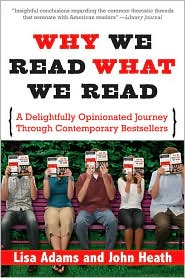
I have been reading an excellent book, Why We Read What We Read by John Heath and Lisa Adams. This book was written after the two authors (a previous author and teacher/editor, respectively) undertook a research project to determine what the best-selling books in America (from the Publisher's Weekly and USA Today best seller lists) tell us about the American psyche.

I have found the book to be interesting and irreverent (which is why I found the book to be interesting). These individuals obviously love books and reading, but they know that many who claim to be "readers" do so without well-formed ideas about what we should be reading to better our minds, bodies, society, etc. The Barnes & Noble website includes reviews from Publisher's Weekly, which not surprisingly is under-whelmed by the text, and the Library Journal, which not surprisingly recommends the book to every public library's collection.

If nothing else, a read of this book might cause you to re-think before you read.